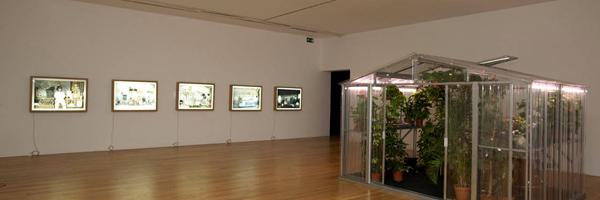
The central theme of the exhibition UNTAMED PARADISES, a co-production by the MARCO of Vigo and the Centro Andaluz de Arte Contemporáneo, is man's relationship with nature. Twenty artists from various backgrounds explore their relationship with the earth they inhabit, revealing different points of view that range from the romantic to the documentary and from the utopian to the environmentalist. Drawing on nature as a subject of observation and contemplation, a testimony, or as a vehicle for denunciation, the works displayed in this exhibition represent the last stop in the evolution of the landscape genre; the culmination of centuries of human enquiry into the somewhat schizophrenic nature of our relations with our surroundings, during which time the iconography of landscape has gone from the splendour of the Renaissance, to the picturesque of the Baroque, and to the notion of the sublime of the Romantic movement.
As a genre, landscape is overexploited; and as a theme, global warming has become the hard currency of political and economic propaganda. We struggle to view nature as a place for mere contemplation as we inevitably associate with it an attitude of awareness. UNTAMED PARADISES shows contemporary artists' re-readings of the classical conventions defining the genre, illustrating the numerous possibilities afforded by a theme which has diversified tremendously in present times and which embraces everything from the search for virgin pastures to 21st century ecological activism.
And underpinning it all is the vision we pursue of these unexplored places, which has been the subject of much research and attention. The exhibition holds up the man-nature dichotomy to analyse the imprint that man has left on his surroundings as well as the constant struggle for supremacy that has always existed between the two. The artist adopts the role of the last ‘romantic' explorer whose determination led us to discover unknown worlds.
Today, our idea of paradise is quite different and has more to do with evocations of enclosed spaces, reserves or dug-outs. Indeed, untamed paradises seem to carry an aura of secrecy, the promise of privilege to a chosen few; of conquerors-turned-explorers, defenders of a vocation that has evolved in parallel with society. Expeditions undertaken in the 20th century were politically motivated and enabled by the advances of technology, and were little inspired by artistic pursuit, the actions of which did not alter the global maps but documented and condensed ‘reality'. The artist draws up a register of remote places, a test not free of critical intent, which oscillates between the utopian and the nostalgic.
The pieces have been arranged into four sections, depending on the artists' various approaches to the exhibition's thematic axis: the force of nature or the spaces that withstand human action, places that resist all attempts to domesticate them - to this section belong the works by Guido van der Werve, Mireya Masó, Thiago Rocha Pitta, Thomas Joshua Cooper y Eric Rosoman; the utopian journey into virgin territories which develops into an inner search (Marine Hugonnier, Nir Evron, Eva Koch, Sergio Belinchón, Alberto Baraya); man and the Earth: scientific collaboration or the search for relationships between artists, scientists, and nature to improve the uses and transformation of natural spaces (Guillem Bayo, Marjetica Potrč, Peter Coffin, Gonzalo Puch, Heather & Ivan Morison); and, lastly, damaged paradises, or the upset to the balance in the relationship between man and nature (Caio Reisewitz, André Cepeda, Roberto Bellini, Rodney Graham, and Cyprien Gaillard).
A quotation by Henry D. Thoreau, included in the curator's text for the catalogue, serves as both a starting point and a summary or conclusion to some of the ideas and feelings expressed in this exhibition:
"I left the woods for as good a reason as I went there. Perhaps it seemed to me that I had several more lives to live, and could not spare any more time for that one. It is remarkable how easily and insensibly we fall into a particular route, and make a beaten track for ourselves. I had not lived there a week before my feet wore a path from my door to the pond-side; and though it is five or six years since I trod it, it is still quite distinct. It is true, I fear, that others may have fallen into it, and so helped to keep it open. The surface of the earth is soft and impressible by the feet of men; and so with the paths which the mind travels. How worn and dusty, then, must be the highways of the world, how deep the ruts of tradition and conformity! I did not wish to take a cabin passage, but rather to go before the mast and on the deck of the world, for there I could best see the moonlight amid the mountains."
Henry D. Thoreau, Walden; or Life in the Woods, 1845