



MARCO Collection, 5. Sequences, landscapes. Jonathan Hernández, Enrique Ježik, Jorge Macchi
File
Coinciding with the exhibition Hai un lugar [There Is a Place], by Alberto Ardid, the MARCO – Museo de Arte Contemporánea de Vigo brings together works by three artists whose practices share important points of connection, although they belong to an earlier generation. Among them is a video from the MARCO Collection, Serial Victim (2001), by Jorge Macchi.
Two of the artists are Argentine — Jorge Macchi (Buenos Aires, 1963) and Enrique Ježik (Córdoba, Argentina, 1961, currently based in Mexico) — while the third is Mexican: Jonathan Hernández (Mexico City, 1972). They share a reflective approach to contemporary reality, the environment, language, meaning, and the ways in which reality is represented.
The posters that define current events from the walls of buildings, the peculiar language of crime reports in newspaper pages, photographs reproduced by the media, or images documenting acts of war all serve as material through which these artists isolate motifs and construct another narrative — as though it were hidden within the original one, or its reverse side.
The exhibition opens to the public on Saturday, May 16, during the weekend closest to International Museum Day, and within the context of the special programme linked to this celebration.
GENERAL INFORMATION / ACTIVITIES
School Programmes
In collaboration with “la Caixa” Foundation
From 19 May, 2026
Schedule: Tuesday to Friday, 10:00–11:30 and 11:30–13:00
By prior appointment: Tel. +34 986 113 900 ext. 200 / ext. 308 / E-mail: comunicacion@marcovigo.com
Programmes for Associations, Community Groups, and Groups with Specific Needs
In collaboration with “la Caixa” Foundation
From 19 May, 2026
Schedule: Flexible, depending on needs and availability
By prior appointment: Tel. +34 986 113 900 ext. 200 / ext. 308/ E-mail: comunicacion@marcovigo.com
Information and guided tours
Gallery staff are available for queries and information about the exhibition, additionally tours are available: every day at 18.00. ‘À la carte’ visits for groups, for reservations please call Tel. +34 986 113900 / +34 986 113908.

Summary
Jorge Macchi
Víctima serial, 2001
Video projection
Edition 1/3
MARCO Collection
Jorge Macchi (Buenos Aires, Argentina, 1963) photographs fragments of text taken from advertising posters in public space, assembling them into a message whose reading is, at the very least, unsettling. We perceive it as familiar, close, recognizable — but the surprise comes when we read the proposed text and discover another reality, one that echoes known stories. As Macchi explains: “With these words isolated from their context, I construct a message with the logic and content of an anonymous threat — the kind built from words or letters of different origins in order to protect the anonymity of the author. Two attitudes overlap in this work: that of the artist, who carries out a kind of word hunt through the city, and that of the fictional, anonymous character lurking behind each poster”.
Jorge Macchi
Doppelgänger, 2004
10 silkscreens, 38.5 × 38.5 cm, on acid-free Starwhite Archiva Smooth paper, 216 gsm
Printed at Enrique Cambón Graphic Workshops, Buenos Aires, November 2004
Edition 40/50
For Doppelgänger, Jorge Macchi selected crime reports from the Buenos Aires newspaper Crónica: “I noticed that certain phrases were used as clichés: ‘lifeless bodies,’ ‘macabre discovery,’ ‘bodies in an advanced state of decomposition,’ etc. I selected pairs of news stories that not only shared the same phrase, but also approximately the same number of words and the same position within each text. This material allowed me to work with symmetrical forms that touch at the point where the news stories share the same phrase, functioning as a bridge between two different stories — a passage between two realities that are formally identical, yet completely different in content.”
From a distance, the forms appear visually attractive, but upon reading, the texts reveal another reality.
Jonathan Hernández
You Are Under Arrest, 2000-2002
6 silkscreens, 43 × 31 cm
Edition 3/30
Artist books and original silkscreen, edition 3/30, displayed in a vitrine
An essential part of Jonathan Hernández’s practice originates in images reproduced in the press, which he selects according to themes or analogies before intervening in them and presenting them as series or publications, such as the project Vulnerabilia (collages, editions, books, and editorial projects), which he has developed for more than two decades.
You Are Under Arrest brings together a selection of photographs collected from the international press since the year 2000. As the artist notes: “Since then, the subject and function of security have increasingly taken center stage around the world. While the ideals of goodness and justice collapse under their own contradictions, insecurity increasingly conditions these fragile times of extreme security.”
Enrique Ježik
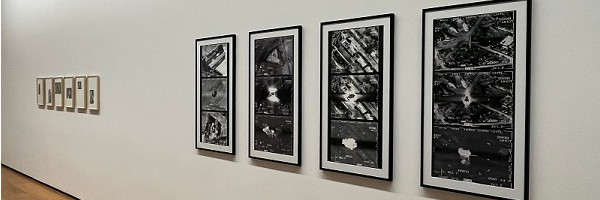
Paisajes, 2006
4 digital prints with pigmented inks on 210 gsm Verona paper
Printed by Factum Arte for La Caja Negra Ediciones, Madrid
Edition 2/15
The work of Enrique Ježik (Córdoba, Argentina, 1961) constitutes a clear, direct, and critical response to institutional violence, mechanisms of repression, torture and domination, and censorship. He frequently employs the very materials originally associated with these systems — including weapons and instruments of war — giving his interventions an extreme radicality, whether in galleries and museums or in public space.
On paper, or in editioned works, the approach is precise and only seemingly poetic. In Landscapes, he shows how a space is destroyed in war. The work draws on images captured from bomber aircraft during the Balkan conflicts, combining in a single sequence the moment a target is identified, the impact of the bomb, and the resulting new “landscape”.
